
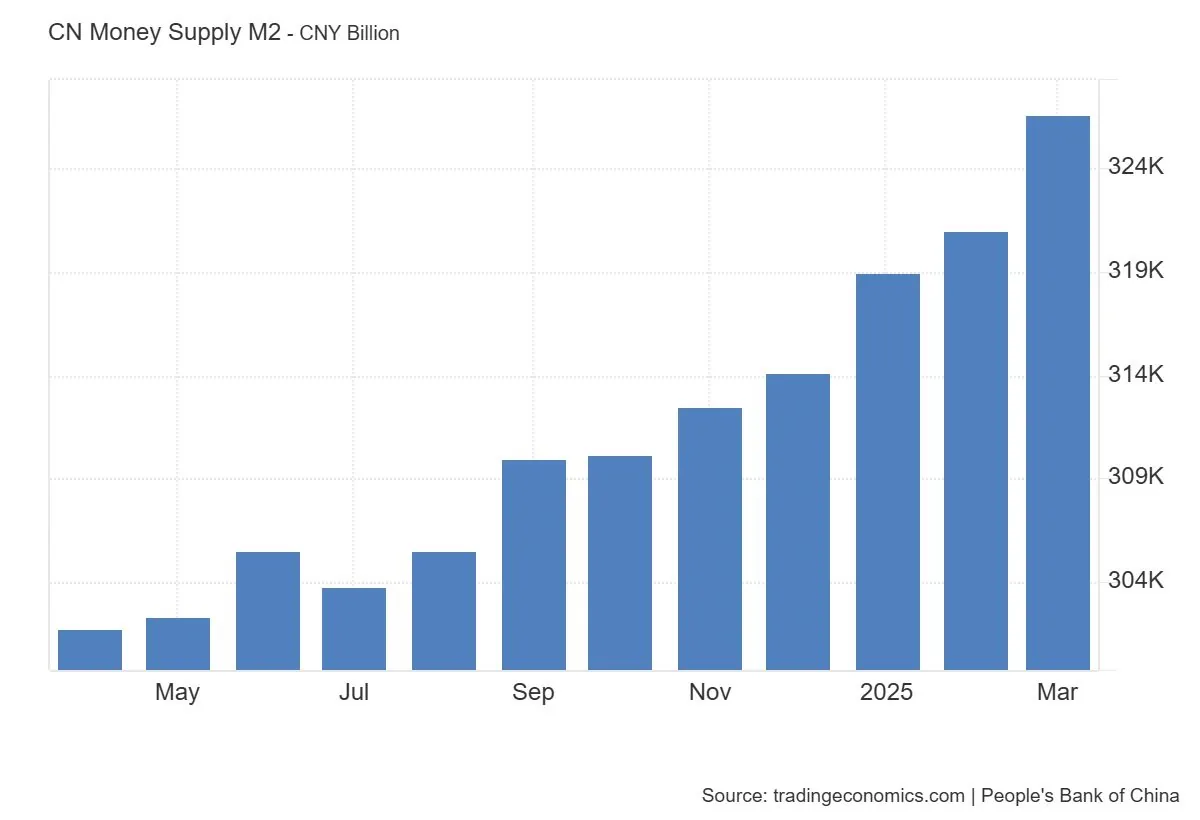
China’s monetary landscape is undergoing a dramatic shift. As of March 2025, the country’s M2 money supply—encompassing cash, checking deposits, and near-liquid assets like savings and time deposits—has surged to an astonishing ¥326.13 trillion (approximately $44.89 trillion). This figure is more than double the U.S. M2 of $21.67 trillion, reflecting the People’s Bank of China’s (PBOC) aggressive monetary policies. But what does this mean for domestic and global financial markets? Let’s dive into the implications for stock markets and pinpoint the asset classes likely to benefit.
Implications for Stock Markets
Domestic Stock Market Rally Potential
- Liquidity Injection: The rapid growth of China’s M2 is a clear sign of expansive monetary measures, including rate cuts and reductions in reserve requirements. This liquidity frequently flows into financial markets, driving asset prices higher. For instance, the CSI 300 Index saw one of its strongest rallies since 2008 following stimulus measures in late 2024.
- Corporate Behavior: When M1 (narrow money) growth surpasses M2, it suggests corporations are holding demand deposits, potentially for equity investment. However, not all funds necessarily make their way into the stock market, with some diverted to offshore markets or speculative assets.
- Market Sentiment: There is a growing belief that China’s liquidity surge is a precursor to broader global monetary easing. This optimism could encourage speculative buying in oversold sectors, such as technology and consumer goods.
Global Stock Market Spillover
- Emerging Markets Exposure: China’s economic significance ensures its monetary policies reverberate globally. The MSCI Emerging Markets Index, heavily weighted toward Chinese stocks, often rallies during periods of liquidity injection.
- Integrated Markets: While U.S. and Chinese stock markets show limited direct causality, regional Asian markets like Japan tend to mirror China’s movements, creating opportunities and risks for investors.
- Commodity-Driven Equities: A boost in China’s M2 generally lifts commodity prices, benefiting related equities in resource-rich countries like Australia and Canada.
Risks and Limitations
- Inefficient Monetary Transmission: China’s unique economic structure means M2 growth doesn’t always translate into traditional monetary effects, often driven by government spending rather than private investment.
- Asset Bubbles: Previous M2 expansions have led to speculative bubbles, posing risks of volatility or corrections.
- Currency Pressure: Surging liquidity increases pressure on the yuan, with potential outflows destabilizing equity markets.
Asset Classes Likely to Benefit
Chinese Equities
Technology, consumer discretionary, and financials are positioned to gain, particularly in indices like the CSI 300 and Hang Seng. Optimistic sentiment and direct PBOC market support strengthen the appeal of small- and mid-cap stocks.
Emerging Market Equities
Funds tracking indices like the MSCI Emerging Markets Index offer exposure to China while diversifying risk. Investors may benefit from liquidity-driven rallies extending across Asian markets.
Commodities
China’s industrial demand boosts prices for metals like copper and aluminum, as well as agricultural raw materials. These trends make commodity-linked equities in countries like Australia and Canada particularly attractive.
Cryptocurrencies
Analysts speculate that China’s liquidity surge could indirectly fuel a rally in Bitcoin and altcoins. However, regulatory uncertainties in China make this a high-risk play.
Real Estate and REITs
Real estate investment trusts (REITs) focused on commercial properties in top-tier cities may benefit from increased housing demand, although risks of oversupply in smaller cities persist.
Gold
Gold remains a safe-haven asset, appealing to investors during periods of uncertainty linked to China’s monetary expansion.
Critical Considerations
Short-term stock market gains from China’s M2 growth are evident, but the long-term sustainability depends on its ability to spur real GDP growth. As the country struggles with deflationary pressures and transitions to consumer-led growth, the future impact remains uncertain. Additionally, global liquidity surges—fueled by recent U.S. Federal Reserve rate cuts—could amplify asset price increases but also raise inflation concerns.
Conclusion
China’s growing M2 money supply presents both opportunities and risks for investors. From stocks and commodities to real estate and gold, the effects of this liquidity injection ripple across global markets. However, inefficiencies in monetary transmission and the potential for asset bubbles mean caution is essential. Diversification and close monitoring of monetary policies are key as China’s economic actions shape broader market dynamics.
Disclaimer: The information provided in this blog post is for informational and educational purposes only and does not constitute financial, investment, or professional advice. The content reflects general market commentary and analysis as of April 15, 2025, and is subject to change without notice. Neither Vivek Sharma nor anyone affiliated with Gwynedd Wealth Partners, LLC guarantees the accuracy, completeness, or suitability of the information provided.
Investing in securities, including ETFs such as $EUAD and $ITA, involves risks, including the potential loss of principal. Past performance is not indicative of future results. Investors should conduct their own research or consult with a qualified financial advisor before making any investment decisions. The mention of specific securities, sectors, or strategies does not constitute a recommendation or endorsement to buy, sell, or hold any investment.
Readers are responsible for their own investment decisions and should consider their individual financial circumstances, risk tolerance, and objectives. For personalized advice, please contact a licensed financial professional.
This blog post may contain forward-looking statements based on current expectations, which are subject to risks and uncertainties that could cause actual results to differ materially. External sources, including web data and posts on X and LinkedIn, have been referenced where applicable, but their accuracy is not guaranteed. Always verify information independently before acting on it.
This article is general information, not personalized advice. Investment advisory services are offered through Gwynedd Wealth Partners, LLC.