
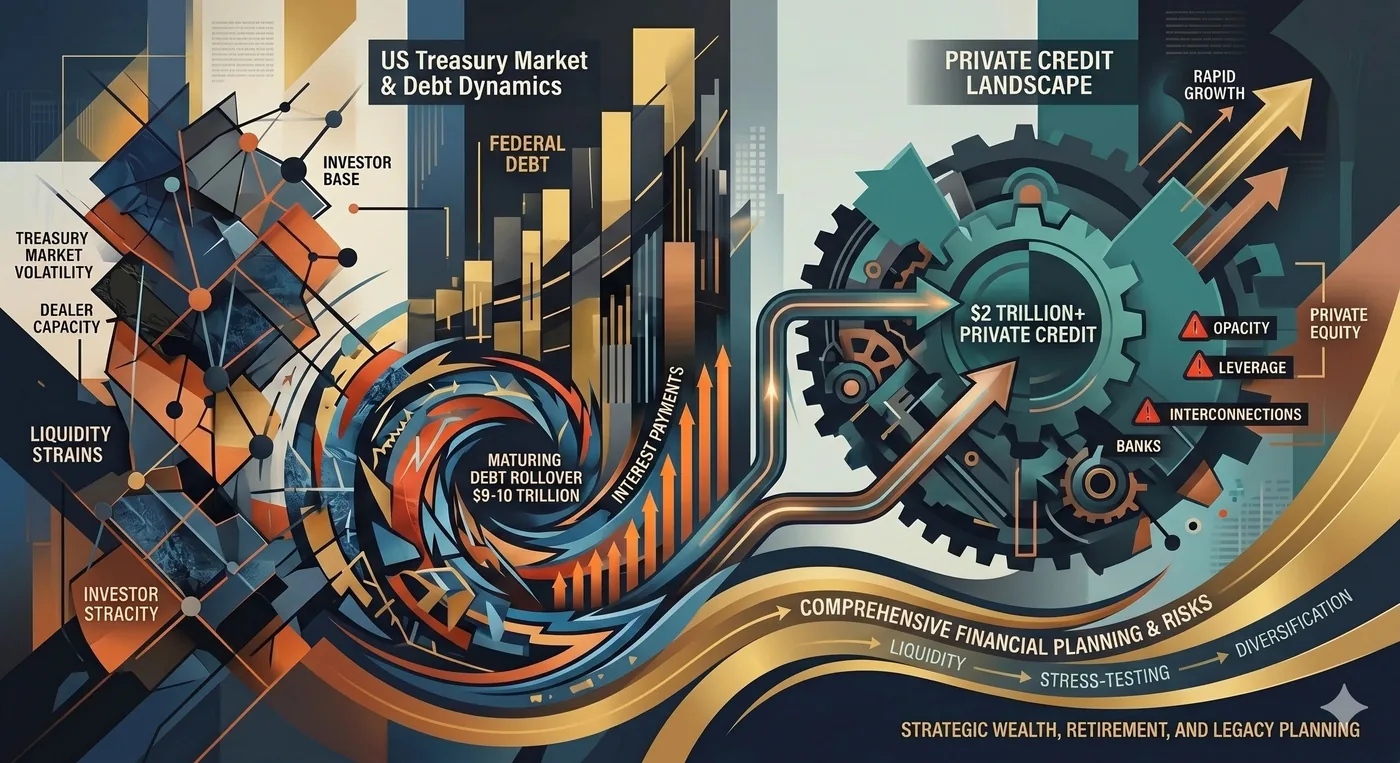
As we continually assess the evolving risks shaping portfolios and long-term planning, two interconnected areas warrant close attention: the structural pressures in the US Treasury market amid rising federal debt, and the rapid growth of private credit markets.
The Treasury Market and Debt Dynamics
US public debt continues to climb, with projections indicating significant increases in the coming years. The government faces substantial rollover needs—around $9-10 trillion in maturing debt in 2026 alone—much of it short-term securities that must be refinanced at prevailing rates.
Net interest payments have already surpassed $1 trillion annually and are expected to grow further, potentially reaching $2.1 trillion by 2036 according to CBO projections. This crowds out other spending priorities and heightens sensitivity to interest rate changes.
Market functioning adds another layer. The Treasury market, the bedrock of global finance, has seen its investor base shift toward more price-sensitive participants. This, combined with dealer capacity constraints and episodic liquidity strains, means volatility can spike during periods of stress—whether from economic data, geopolitical events, or fiscal developments.
These dynamics don't signal immediate crisis, but they underscore the importance of monitoring fiscal sustainability, auction results, and term premiums.
Private Credit: Opportunities and Interconnected Risks
Private credit has expanded rapidly as an alternative to traditional bank lending, now exceeding $2 trillion in scale. It provides flexible financing for businesses but also introduces opacity, leverage, and interconnections with banks, insurers, and private equity firms.
Recent FSB and IMF analyses highlight potential vulnerabilities: valuation challenges, exposure to sectors like software amid technological disruption, and liquidity mismatches in semi-liquid structures. While the sector hasn't faced a full credit cycle stress test, interlinkages could amplify shocks if economic conditions tighten.
Implications for Investors and Planning
For clients, these developments reinforce the value of comprehensive financial planning. Key considerations include:
- Portfolio positioning: Balancing duration exposure, maintaining liquidity buffers, and diversifying beyond traditional fixed income.
- Risk management: Stress-testing for higher rates or volatility scenarios, with attention to behavioral factors that influence decisions under uncertainty.
- Holistic strategies: Leveraging tax efficiency, estate planning, and alternative allocations where appropriate, while prioritizing high-quality, resilient assets.
At our practice, we focus on translating these macro realities into personalized guidance that supports your goals—whether preserving wealth, funding retirement, or building generational legacies. Markets have proven resilient, supported by policy tools and economic adaptability, but proactive preparation remains essential.
We encourage ongoing dialogue to ensure your plan accounts for these and other evolving factors. Reach out to schedule a review.

Disclaimer: The information provided in this blog post is for informational and educational purposes only and does not constitute financial, investment, or professional advice. The content reflects general market commentary and analysis as of June 6,2026, and is subject to change without notice. Neither Vivek Sharma nor anyone affiliated with Gwynedd Wealth Partners, LLC guarantees the accuracy, completeness, or suitability of the information provided.
Investing in securities involves risks, including the potential loss of principal. Past performance is not indicative of future results. Investors should conduct their own research or consult with a qualified financial advisor before making any investment decisions. The mention of specific securities, sectors, or strategies does not constitute a recommendation or endorsement to buy, sell, or hold any investment.
Readers are responsible for their own investment decisions and should consider their individual financial circumstances, risk tolerance, and objectives. For personalized advice, please contact a licensed financial professional.
This blog post may contain forward-looking statements based on current expectations, which are subject to risks and uncertainties that could cause actual results to differ materially. External sources, including web data and posts on X and LinkedIn, have been referenced where applicable, but their accuracy is not guaranteed. Always verify information independently before acting on it.
This article is general information, not personalized advice. Investment advisory services are offered through Gwynedd Wealth Partners, LLC.